Meet Jonathan Reis: the electronics engineer who tests the idea before the budget
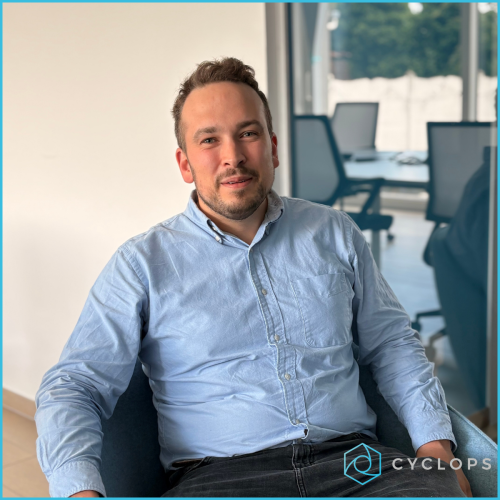
New faces at Cyclops. This time, an industrial engineer who co-founded an IoT company and thinks connectivity belongs in the basic engineering, not in the patches afterwards.
Jonathan joined Cyclops as a Project Manager a few weeks ago. Industrial engineer, minor in electronics, five years as a founder. Most of his career has come down to one thing: turning what a client says they want into something that can actually be built.
From a thesis to a production line to a company
He studied at ULB, then took his industrial engineering degree in Arlon, a broad programme covering construction and mechanics, with electronics as his own focus.
His thesis took him to a Brussels startup studio, working on integrating electronics into free-floating electric bikes. Before he formally started there he spent a month with the client. „I went and set up their production line for installing the electronics.” Then a year later as a hardware engineer, taking projects from a defined electronics need to a working prototype.
Then, Jonathan and his team decided to spread their wings.
„The team worked well, we got on well. So the five of us decided to launch a company to do exactly what we were doing, but outside of a startup studio.”
ATLR Engineering did what the five of them had done at beforehand: build the electronics behind other people’s products, mostly IoT, for SMEs and startups. Being a founder meant everything else came with it: recruitment, bank loans, Walloon funding files, while the projects carried on regardless.
Two projects
1. A thermal battery.
A two-year R&D project backed by the Walloon Region, run by a consortium of industry and academic partners with ATLR on the electronics. The product stores energy as heat in a phase-change material, so a household with solar panels and a heat pump keeps its own production instead of exporting it.
Jonathan joined as project manager for the electronics and ended up considerably broader than that. „I had a bit more of a CTO role within the project itself, because a lot of things came back to me. I oversaw the R&D during the last year.” Fifteen people, with a dedicated scheduler alongside him. „My scope was more managing the different engineers, and taking the decisions.”
2. An interactive perfume wall.
For a luxury perfume house based in Oman. Transparent resin pieces with a scent and an RFID tag inside: place one on the consultation table – an RFID reader – and the matching fragrances light up.
The electronics were the easy part. Jonathan installed the system in a store in China and ran assemblies in Dubai, Saudi Arabia and London.
„I really had to be on site, managing the electrical teams together with the construction manager on the ground. We don’t all work the same way in China, in Saudi Arabia. It was a lot of managing teams remotely, being reactive on site, adapting the product to what was actually available, because a store gives you access to certain things and not others.”
What Jonathan does before a project starts
Jonathan spent a lot of his time at ATLR in the ideation phase, and that’s the part he calls hardest.
„A client with a very clear idea in his head, where the idea isn’t feasible or isn’t well optimised, and you have to bring him round and explain that this isn’t the technology to use, and how to adapt his product.”
He also watches for the product that tries to do everything. „You have to understand the real value of what he wants to put on the market, so you don’t develop a Swiss army knife, a knife that does everything, badly.”
That maps straight onto the Cyclops job. „The client arrives saying: I want to build a new production line. And maybe that isn’t the solution. Maybe his existing line isn’t optimised enough. You have a need, you have requirements, you have technical solutions, and you make them all work together.”
He’s equally clear about his gaps. „On construction I’m a lot less advanced than some of our other consultants. I’m counting on being able to lean on colleagues here at Cyclops.”
And he brings one startup habit that belongs in a feasibility study: „Test the idea quickly and work out whether it’s functional, rather than charging straight into a big development and then realising you’ve spent a lot of money and the solution doesn’t work.”
Why electronics has to be in the basic engineering
His first assignment is a fire alarm system for an industrial client: a central unit over ten years old, no longer meeting requirements. A competitor proposed replacing everything. The client would rather change what’s no longer good.
It’s a good example of what’s changed in his field. „The standards are opening up for connected fire systems, systems with cameras rather than just smoke detection. Sirens used to make one continuous noise. Now you can have sirens that distribute information. You can use certain cables to detect temperature differences.”
Behind that sits Industry 4.0. „What matters is being able to take the data, bring it to a backend, and make it work together. If a motor is drawing 30% more than it did at the start, there’s probably a problem with that motor. If you know that in advance, you consume less and you repair before you have the real problem.”
Which is an argument to make while the budget is still open.
„You can tell the client: yes, it looks more expensive now, but if we propose it in the basic engineering, it opens up a lot of options later for the experts who finish the project. It’s much better to develop it when you’re designing the building: the cable routes, the communication paths, the topologies, than to end up putting patches on patches.”
He sees a second role in that too. „I can support a team installing the PLC automation, and give them someone inside Cyclops who properly understands what they need.”
Why this matters to us
Cyclops projects are electromechanical. Increasingly they’re also connected: sensors, data, predictive maintenance, systems that have to talk to each other. That layer is cheap to get right in the basic engineering and expensive to retrofit, and it needs someone in the room early.
Jonathan brings that, plus five years of sitting with clients who knew what they wanted and working out with them what they needed instead.
Welcome to the team, Jonathan.