Ten years of Cyclops: Tristan Vercruysse on growth, wisdom and the art of the stupid question
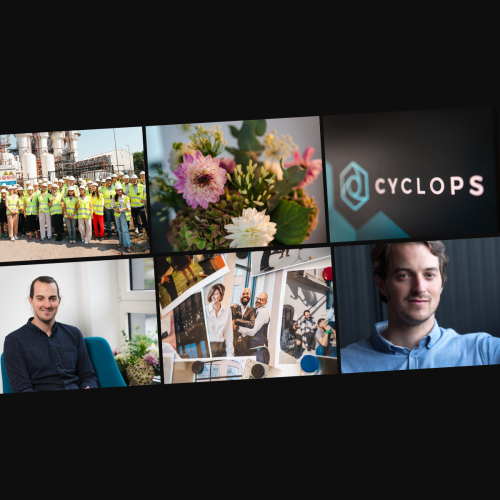
When Tristan Vercruysse joined Cyclops, the company barely counted ten people. Today we are more than forty, spread across four office moves, dozens of clients, offices in Belgium and Poland, and an industry that has changed considerably in the meantime.
In an era of job hopping and LinkedIn updates every eighteen months, a decade at the same company is worth pausing over. We asked Tristan what those ten years have taught him: about project management, about himself, and about why the future of Belgian industry may well depend on how quickly renewable energy becomes affordable.
Day one: straight into it
Tristan still remembers his first day well. Or rather, the day before it. “I think I already drove to Ghent on the Friday before my official start date to pick up my company car. So that I could get going right away on Monday and skip all the paperwork.”
That eagerness to begin turned out to be useful preparation, because his first project, at a large pharmaceutical client, threw him straight into the deep end. No experience with project management, a demanding environment, and little time to catch up. Rob guided him through those first days: what a project is, what people expect from a project manager, how to approach the role. “I learned an enormous amount in a very short time,” Tristan says, “In a not particularly easy environment.”
Three words for ten years
When we ask him to sum up his ten years in three words, he hesitates for a moment. “I’m not good at summing things up in three words.” But he gives it a shot:
Instructive. Responsibility. Collegial.
Poetic, for someone who claims not to be good at it.
From stickler to calmer project manager
Ten years changes things, including yourself. Tristan describes his earlier self as a genuine stickler for detail. “I was rather nervous in my projects. Everything had to go perfectly, and when it didn’t, I immediately looked at myself: what did I do wrong?”
Today he sees it differently. “As a project manager, you simply don’t control everything. There are things that just come at you. I’ve become calmer about that.” That shift has had an effect on the people around him as well. “In my first project I rubbed quite a few people the wrong way. I created stress in others that ultimately didn’t help. I’ve been able to temper that, and projects go much better as a result.”
A lesson that reaches well beyond a project schedule.
Lessons learned along the way
One lesson stayed with Tristan from the very beginning: more people on a task is not the same as more progress. Some work simply cannot be compressed, no matter how many hands you put on it. “You really have to think carefully about whether extra manpower actually adds anything. The plan looks good, but reality is more complex.”
A second piece of wisdom that Tristan also applies in his private life: think win-win. “Even when you know you’re right and the other person is wrong, you have to look for a solution where nobody loses face. If you push someone into a corner, you both lose. And that helps no one, not at work and not at home.”
The drive after ten years: affordable renewable energy
What keeps someone motivated after a decade? For Tristan the answer is surprisingly concrete: energy. Or more precisely, the lack of affordable renewable energy for Belgian industry.
“Every time I read that a company is leaving our country because of high costs, I see that the energy bill plays a significant part in it. And that affects me. Because if we want to preserve our prosperity in Europe, our industry has to stay here. And that is only possible if we handle energy more intelligently.”
Driven by that conviction, he completed an energy management course within Cyclops. He is now working to translate that knowledge into what Cyclops can offer its clients: bringing consumption down and helping plants move to renewable sources at a cost that holds up. “We work for a great many different companies. Nowhere else do you have such a broad opportunity to make an industry-wide impact on energy consumption. That motivates me enormously.”
What has changed, and what has not
Cyclops is no longer the ten-person company it was when Tristan started. Four office moves and an expansion to Poland later, there are more than four times as many colleagues and a great deal more structure.
But not everything has changed. “That drive to deliver projects well, to give the client something good, has always stayed.”
His advice to anyone starting
What does someone with ten years of experience say to someone just starting out?
“Go for it. Commit. Take responsibility on the project.” And then, perhaps the most empowering piece of advice: dare to be vulnerable. “Dare to show that you don’t know something. After ten years, I don’t know everything either. But by showing that, you learn faster and you solve problems better.”
And specifically for project managers: ask the stupid questions. “You work with experts who often look at things from their own point of view. Two experts who are both right but cannot find middle ground: that is a guaranteed recipe for delay. If you don’t ask the stupid question, nobody finds that middle ground. It is no sin not to know something.”
What makes Cyclops different
Tristan has seen his share of the market. So what sets Cyclops apart?
“There are very few companies that focus purely on project management. At engineering offices, PM is often a side issue, and the main event is the discipline engineers. With us it is the other way around. Project management is our core business. We think about it constantly, we learn from each other, we train for it.”
The second difference: people are not numbers. “We don’t see colleagues as the next project manager we can place somewhere. That is something I hope we can preserve as we continue to grow.”
–
Tristan Vercruysse is Senior Project Manager at Cyclops. He works on projects in the pharmaceutical sector, the food industry and the steel industry, with a particular focus on renewable energy and energy management in industrial environments.